Bubbu School - My Virtual Pets
- 3.8
- Rating
- 50.00M
- Installs
- Free
- Price
 Analysis by App-foxy
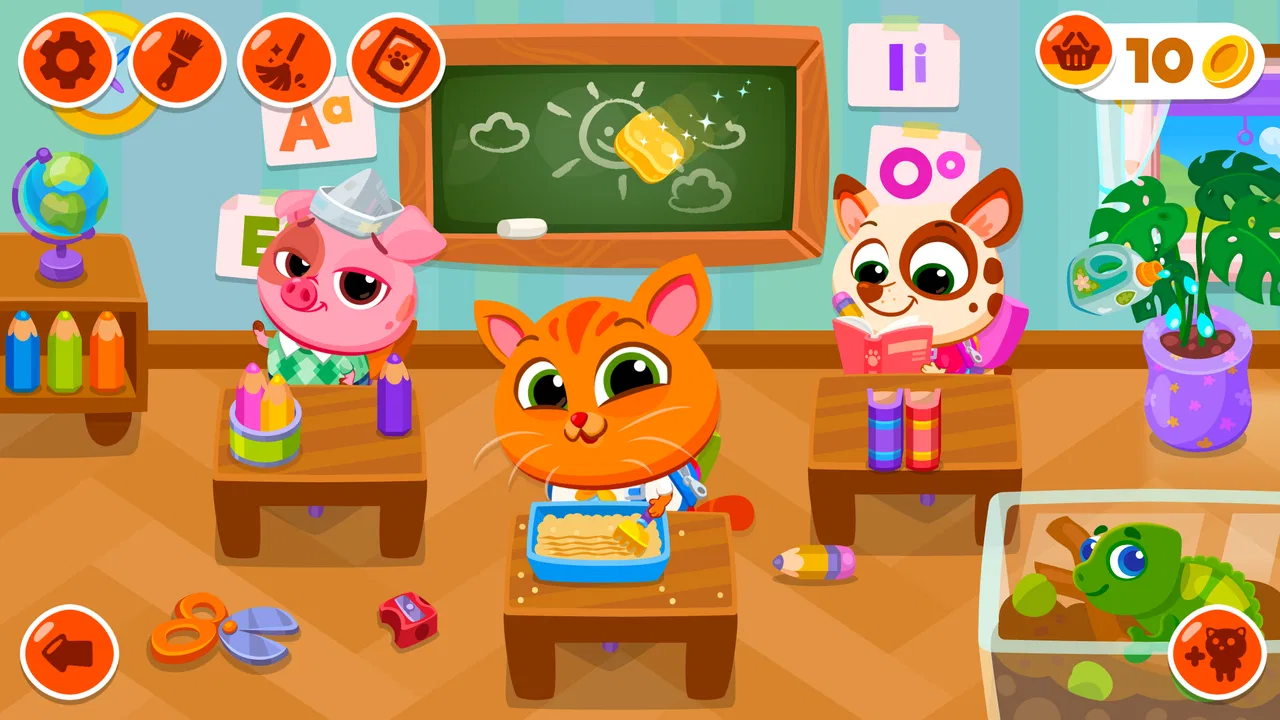
I spent time with Bubbu School - My Virtual Pets as a children’s educational game, and its appeal became clear almost immediately: it turns a school day into a series of small, friendly activities with animal characters. Instead of asking a child to sit through a formal lesson, it encourages short bursts of drawing, music, and playful interaction. That makes it easy to approach, especially for children who respond better to doing something than to reading instructions.
The game is made by Bubadu, is free to start, and is suitable for Everyone. It has reached over 50 million installs, which tells me it has found a broad audience among families looking for a gentle mobile activity. Its average rating is 3.9 from around 147 thousand ratings, so the reception is positive but not flawless. That feels fair: the game is approachable and charming, yet it is also quite simple and includes optional purchases that parents should understand before handing over a device.
How the school-day loop works
I find the school-day loop easiest to understand when I treat each activity as a short invitation rather than a lesson that must be completed. That mindset helps me decide when to let a child explore independently and when to join in with a question or suggestion. Next, I’d look at a few simple checks that can make a first session feel less confusing.
You May Also Like

 Blood Strike: 2.5 Anniversary
Blood Strike’s Loadouts Turn Every Drop Into a Tactical Gamble
A close look at Blood Strike’s custom loadouts: how fast access to signature weapons reshapes its battle royale rhythm, rewards preparation, and narrows the gap between fights.

 Pandora - Music & Podcasts
Pandora’s Music Is Easy to Start, but Harder to Recover
Pandora’s strength is its low-effort path from a seed to a station. Its weak spot is how much confidence it asks you to place in connection, setup, and quiet recovery.

 8 Ball Pool
 Is Built on Rivalries, Rematches, and Routine
A close look at the rivalries, rematches, shared routines, and unanswered safety questions that turn a quick pool match into a persistent mobile community.

 Samsung Music
’s Quiet Strength Is Playing What You Already Own
Its reach comes less from spectacle than from dependable access to a personal library. That simplicity is both the app’s strongest retention engine and its ceiling.

 AccuWeather: Weather Radar
AccuWeather Review: A Quick, Clear Forecast for Everyday Decisions
For everyday plans, the best forecast is the one you can understand quickly. AccuWeather makes rain timing, radar, and local conditions easy to act on, with a few trade-offs.

 Hill Climb Racing
Why Hill Climb Racing Still Turns Crashes Into One More Run
A tiny car, a bumpy hill and one more upgrade: Hill Climb Racing keeps resurfacing because its simple chaos makes every near-miss feel personal.
More From Our News Desk
View All News


The first action is deliberately easy
The strongest design choice is that the game does not make a child work hard to begin. The animal-school setting gives the experience a recognizable frame, while the activities themselves are presented as things a young player can try without much explanation. Drawing and music are particularly useful starting points because they invite direct action: touch the screen, make a mark, choose an interaction, and see what happens.
That first action matters more than it may seem. A child who is still learning how to control a touchscreen can begin with experimentation rather than precision. I found this more welcoming than many educational apps that open with a quiz, a reading task, or a sequence of instructions. Here, the feeling is closer to entering a playful classroom where trying something is already part of the lesson.
The drawing activities are not a replacement for a structured art course, but they can help children become comfortable with basic visual gestures. A parent can sit beside a child and ask what they are making, why they chose a particular mark, or what they would change. That turns a short game interaction into a conversation about shapes, colors, imagination, and decision-making.
The music side works in a similar way. It gives children a reason to tap, listen, and repeat. I would not treat it as formal music education, but it can make rhythm and sound feel approachable. For a child who enjoys making noise and trying combinations, this is likely to be more motivating than a lesson that starts with terminology.
Feedback keeps the activity moving
The game’s feedback rhythm is built around immediate responses to what the player does. Young children generally need that quick connection between action and result, and this is where the animal theme helps. The characters make the experience feel warmer than a worksheet or a plain practice tool, so even a small success can feel like part of the school-day story.
I also noticed that the feedback is useful for maintaining attention without demanding long concentration. A child can try something, observe the response, and decide whether to continue or switch activities. That short cycle is a good fit for a waiting room, a quiet moment before dinner, or a brief break when a parent needs an activity that does not require a full television episode.
There is a trade-off here. Immediate feedback is encouraging, but it does not necessarily explain why an answer or action is better than another one. The game works best as an introduction to creative and playful learning, not as a detailed teaching system with carefully graduated explanations. If your main goal is spelling, mathematics, reading fluency, or measurable academic practice, a dedicated learning app will usually provide clearer instruction and progress tracking.
For younger players, however, the lack of pressure can be a strength. I would rather see a child willingly return to a simple creative task than abandon a more advanced app because the first screen feels like homework. The experience is especially suitable when the goal is to encourage curiosity, hand-eye coordination, and confidence with basic digital interaction.
Rewards make another try feel worthwhile
The reward in this game is less about a complicated achievement system and more about the satisfaction of completing a small activity with the virtual pets nearby. The animal characters give the child a reason to care about the setting, while the activities provide something concrete to do. That combination creates a gentle sense of progress even when the player is not chasing a demanding score.
This is one reason I can imagine the game working well as a shared parent-and-child activity. A parent can let the child lead, then ask them to demonstrate a favorite task or explain what happened in the classroom. The child gets recognition for making choices, and the adult gets an easy opening for conversation. That is more valuable than simply using the game as background entertainment.
There is also a practical benefit to the small reward cycle: it supports short sessions. A child does not need to commit to a long campaign or remember a complicated story. They can finish a little activity, enjoy the response, and stop. For families trying to keep mobile play contained, that natural stopping point is helpful, although adults should still set the actual time limit.
Parents should pay attention to the purchase model. The game is free, but optional in-app purchases range from $0.99 to $49.99 per item. That wide range makes it important to use the device’s purchase controls and discuss what “free” means before a child plays alone. I would not give a young child unrestricted access to the payment screen, even if the core experience is suitable for children.
Resetting the session is part of the appeal
After an activity ends, the experience is easy to restart because the game is not built around a heavy narrative that must be remembered. The player can return to the school setting, choose something else, or repeat a familiar kind of play. That reset is useful for children who want consistency one day and variety the next.
In a realistic everyday situation, I could see a parent using it during a short afternoon transition. A child has finished a snack but needs to wait while an adult prepares the next activity. The child opens the game, spends a few minutes drawing or playing with the musical side, receives friendly feedback, and then stops when the parent says it is time to move on. Because the interaction is self-contained, there is less pressure to reach a dramatic story point before closing the app.
The same reset can be a weakness for older children. Once the novelty of the animal school wears off, players who want deeper challenges may feel that they are repeating lightweight activities rather than mastering a growing set of skills. This is where the game differs from structured educational platforms that build lessons in a fixed sequence. Those alternatives may be better for children who need clear goals, regular assessment, or a visible path from beginner to advanced work.
I also recommend that adults try the game first and decide which activities feel appropriate for the child’s age and attention span. “Everyone” is reassuring as a content rating, but children within that broad group can have very different abilities. A preschooler learning basic touch control, a child practicing creative expression, and an older child seeking academic challenge will not get the same value from the same session.
What makes the loop work, and where it stops
The complete loop is simple: choose an activity, make an action, receive an immediate response, enjoy the result, and begin again when the mood strikes. That simplicity is the reason the game is accessible. It removes the fear of failure and makes the next session feel available without requiring preparation.
My main criticism is that the loop can become shallow if a child plays for long periods. The game offers a pleasant reason to return, but not every return necessarily adds a new layer of understanding. I would use it as one item in a child’s activity mix, alongside drawing with real materials, listening to music, reading together, and playing away from the screen. It succeeds as a friendly digital classroom, not as a complete educational plan.
The comparison with ordinary alternatives is revealing. A video for children is easier to consume but gives less opportunity to act. A paper coloring book encourages creativity without screen interaction, but it cannot provide the same immediate animated response. A formal learning app may teach a narrower subject more thoroughly, while this game offers broader, lighter exploration through its animal-school setting. The right choice depends on whether you want engagement, practice, or academic structure at that moment.
I would recommend it to families seeking a low-pressure game for creative play, especially when a child enjoys animals and likes switching between activities. It is also a reasonable first step for a young player who is becoming familiar with touch controls. I would skip it if you are looking for advanced lessons, detailed progress reports, competitive challenge, or a completely purchase-free environment.
The current version is 1.65 and it runs on Android 6.0 or later, so families using older devices should check compatibility before planning around it. The game was released on October 25, 2020, and its established install base suggests that it is not an obscure experiment. Still, popularity should not replace a quick hands-on check: children differ widely in what keeps them engaged.
After using it, my view is that the game’s best quality is its approachable rhythm. The first action is easy, the response arrives quickly, the animal setting adds warmth, and the session can end without a complicated commitment. Its real strength is making a small amount of playful learning feel inviting rather than demanding.
That is also the right way to judge it. I would not install it expecting a full curriculum or a long-term substitute for guided learning. I would install it for short, supervised moments when a child wants to draw, explore sound, and interact with cheerful virtual pets. With sensible screen-time and purchase controls, Bubadu’s game is a pleasant educational option for younger children, provided parents are comfortable with its simplicity and its optional spending model.
In the end, I see it as a repeatable little activity space rather than a destination game. You enter, do something, see the result, and decide whether another round sounds fun. For the right child, that is enough to make the next session worthwhile; for a child ready for deeper academic challenge, it is better treated as a supplement than a main learning tool.
A smoother first session for a young player
Before giving the device to a child, I would open the game myself and explore the starting choices. This is not because the experience is complicated, but because a quick adult preview helps you see whether the child can move between activities without needing repeated help. It also lets you decide where to pause and how to explain the purchase controls, rather than handling those questions in the middle of play.
If a child seems unsure what to do, I would avoid giving a long explanation. Start with one visible action, such as trying the drawing or music activity, then let the child discover the response. If they get stuck, return to the main school setting and choose a different activity instead of insisting that they finish the first one. The game’s short-loop design makes changing direction feel natural.
When a hiccup may be outside the game
If something does not respond as expected, I would first check the basics: confirm the device is running a compatible Android version, make sure the screen is registering touch normally, and close and reopen the game if it appears temporarily unresponsive. For a child, a brief pause can feel like a major failure, so a calm reset is often more useful than trying several changes at once.
It also helps to separate a gameplay question from a device issue. If touch input is unreliable in other apps too, the problem may be with the device rather than this game. If the game opens but a child cannot find a preferred activity, take a moment to explore the school setting together; a simple demonstration is more reassuring than assuming the activity has disappeared.
Who will get the most from it
I see the best fit as a younger child who enjoys animals, likes experimenting, and benefits from an adult nearby to turn play into conversation. It can also work for siblings taking turns: one child can choose what to try, while the other guesses what might happen or comments on the result. That small shared routine gives the activities a social purpose without requiring a formal lesson.
By contrast, I would choose another option for a child who wants a clear academic target, sustained difficulty, or evidence of skill growth. A focused learning tool is better for practicing a particular subject, while real paper and instruments offer richer hands-on exploration. The game is most useful in the middle ground: more active than watching a video, lighter than a lesson, and easy to put down when the moment is over.
A practical choice, with sensible boundaries
Parents wondering whether it is suitable to hand over unsupervised should consider both the child’s age and the purchase setup on the device. The Everyone rating makes the content broadly approachable, but it does not remove the need for an adult to set payment safeguards. I would also agree on a stopping point before play begins, especially if the child tends to move from one activity to another without noticing time passing.
Bubbu School - My Virtual Pets is a good pick when the aim is a cheerful, low-pressure activity rather than a full teaching program. I like that a child can begin with a simple action, switch to another kind of play, and finish without being pushed through a long sequence. Keep expectations modest, preview it together, and protect purchases; under those conditions, it can earn a useful place among a family’s short creative activities.
FAQs for Bubbu School - My Virtual Pets
01What is Bubbu School - My Virtual Pets about?
Bubbu School - My Virtual Pets is an engaging educational game where players can explore a virtual school environment with adorable pet characters. The app combines learning and fun, offering various mini-games and activities that encourage creativity and problem-solving skills. It's perfect for children who enjoy interactive and educational gameplay.
02Is Bubbu School suitable for all ages?
Bubbu School is designed primarily for children, typically aged 4 to 10. The content is age-appropriate, focusing on basic educational concepts and creativity. However, parents should review the app's content to ensure it aligns with their children's learning needs and interests before downloading.
03Does Bubbu School require an internet connection?
Bubbu School can be played offline, allowing children to enjoy the game without the need for a constant internet connection. However, certain features, such as updates or additional content downloads, might require internet access. Always check the app permissions to understand what functions need connectivity.
04Are there in-app purchases in Bubbu School?
Yes, Bubbu School offers in-app purchases. These can include additional content, characters, or features to enhance the gameplay experience. Parents should monitor and manage these purchases through parental controls to prevent unauthorized transactions by children.
05What platforms is Bubbu School available on?
Bubbu School - My Virtual Pets is available on both Android and iOS platforms. It can be downloaded from the Google Play Store for Android users and the Apple App Store for iOS users. Always ensure your device meets the app's system requirements for optimal performance.
Pros
- Engaging and educational gameplay.
- Colorful and appealing graphics.
- Variety of mini-games included.
- Encourages creativity and learning.
- User-friendly interface for kids.
Cons
- In-app purchases can add up.
- Limited offline functionality.
- Some ads may interrupt play.
- Requires regular updates.
- May not engage older kids.

Bubbu School - My Virtual Pets
Gallery